

Each autumn, the nation comes to a standstill for its notorious college admissions test.
Shops are shut, air travel is postponed to reduce noise, and even the rhythm of the morning commute decelerates for the test-takers.
As evening approaches, most test-takers exit of school gates, breathing a sigh of relief and greeting the family members standing by.
But not everyone finishes at that hour. After darkness has fully settled and night has set in, certain test-takers are still in the exam room – completing close to 22:00.
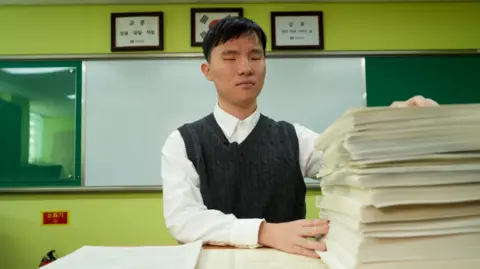
They are the blind students, who frequently spend more than 12 hours taking the longest version of the college entrance exam.
The Endurance Test
On Thursday, over 550,000 examinees nationwide will take the Suneung – an abbreviation for College Scholastic Ability Test in Korean. This represents the largest figure of test-takers in almost a decade.
The test doesn't just determine if people will be able to go to university, but may influence their job prospects, earnings, where they will live and including personal connections.
Depending on their selected disciplines, examinees complete roughly two hundred questions across Korean, mathematics, foreign language, science subjects, an additional foreign language, and Hanja.
Typically, this constitutes an full-day marathon of consecutive exams. Starting the examination at 8:40 AM and conclude approximately 17:40.
Visually impaired test-takers with severe visual impairments, though, are given almost double the regular exam time.
Consequently, when completing the additional foreign language part, the exam can finish as far as 9:48 PM – almost 13 hours after it began.
Without any dinner break; the exam proceeds uninterrupted.
The substantial volume of the braille test papers also contributes to the duration.
When every sentence, symbol and chart is transformed into braille, every exam document becomes six to nine times thicker than the regular version.
Personal Experiences
At Seoul Hanbit School for the Blind, teenage a student is among the students who are preparing for the most extended form of the Suneung this year.
Previously, there were 111 visually impaired examinees nationwide – 99 with partial sight and twelve with severe visual impairments like Dong-hyun – according to data from educational authorities.
Dong-hyun was visually impaired from birth and is unable to perceive light.
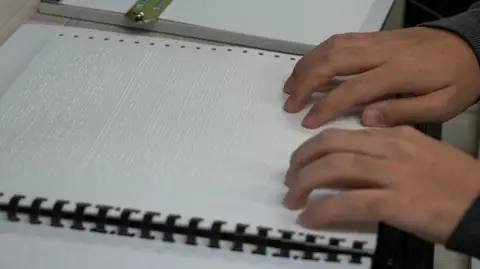
When meeting at his school, his hands moved rapidly across a braille practice booklet of previous test problems.
With just a week left, he was concentrating on maintaining his stamina and physical state. Dong-hyun will take the exam using tactile materials and a audio assistance device.
"The fatigue is significant because the test duration is extensive," he said. "However, no unique method exists. I simply adhere to my study schedule and attempt to maintain my condition. That's the only way."
The student explained the Korean language section is especially challenging for him.
A standard test booklet for this part is about 16 pages – but the tactile edition is about one hundred pages long.
Despite using screen-reading software, verbal content vanishes as soon as it is heard, unlike written content that can be seen and reviewed. He has to retain information in his recall as he goes.
Math component is no easier.
He needs to comprehend complex graphs and tables that have been transformed into braille, using only his fingertips.
Nevertheless, he noted that things are better than they used to be. In the past, students had to do almost all computations in their heads. However, recently, blind test-takers have been allowed to use a braille notetaker, called Hansone.
"Similar to sighted students document their calculations in pencil, we input them in tactile format on the Hansone to track progress," he explained.

Physical Demands
A different examinee at the institution, teenage Oh Jeong-won, who will likewise complete the Suneung this year, said the late afternoon are "the hardest point" of the session.
"Up until lunch, it's tolerable," he said. "But around 4 or 5pm, following language sections and before Korean History, that period it gets really tough.
"Without an evening meal," he explained. "We continue answering questions during the time we would normally eat, so fatigue increases. Still, I keep going because I understand there will be a feeling of achievement at the conclusion."
For the student, the fatigue is compounded by the necessity to stay intensely focused with both his hands and his hearing.
"While processing the braille with my fingers and also taking in content through audio, it feels much more tiring than it does for sighted students," he described.
Study Challenges
But the students explain that the test duration and the extended preparation are not the hardest part. What is most challenging is availability of study materials.
Common educational materials and online lectures that those with vision depend on are often out of reach.
Limited numbers of tactile editions, and converting materials into sound needs having text files – which are difficult to obtain. Frequently, individuals must personally input entire workbooks to create accessibility.
Online lectures present additional challenges, as many instructors explain concepts using visual notes, diagrams and images on screen, which are inaccessible through sound only.
A major obstacle, though, is the delay in obtaining tactile editions of the state-produced EBS preparation books – a essential collection of resources directly connected to the standardized test.
Due to this postponement, blind students frequently obtain the materials months later than others.
"Sighted students receive materials early in the year and study them for the whole year," said Jeong-won. "We receive the braille files approximately in late summer, when the exam is just a few months away."
Dong-hyun shared the identical worry.
"The braille materials weren't ready until less than 90 days prior to testing," he mentioned. "I consistently hoped the publication process could be faster."
The responsible organization, which produces the braille version of EBS exam materials, stated that the procedure requires minimum 90 days for each book because it must follow relevant guidelines.
The institute added that it is "making various efforts to ensure that visually impaired examinees can learn uninterrupted, including producing and providing the resources in separate volumes."
The Korean Blind Union indicated it has consistently presented this issue with {author
